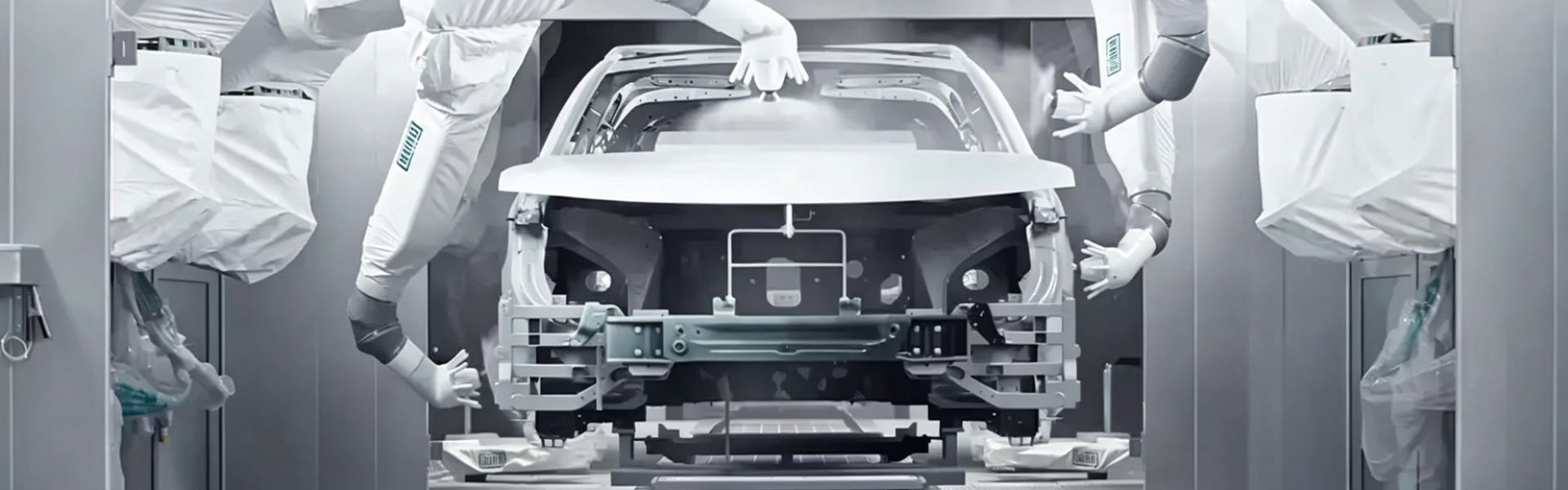
Passenger Vehicle Coating Line
Passenger Vehicle Coating Line --India EV Paint Shop
The India EV Paint Shop project was developed based on a mature passenger vehicle coating process, with targeted optimizations for local high-temperature and high-humidity conditions, as well as the enhanced protection requirements of new energy vehicle structures and underbody components.
During project execution, modular design, 3D simulation, and a remote delivery support system were integrated to improve engineering quality and project execution efficiency while also preparing the line for future capacity expansion.
1. Pretreatment (PT)
The pretreatment process includes degreasing, rinsing, surface conditioning, and thin-film phosphating to thoroughly clean and chemically treat vehicle body surfaces.
During the design stage, a modular design approach was adopted to pre-integrate equipment and piping systems, reducing on-site installation complexity. At the same time, 3D simulation technology was used to complete equipment layout verification and pipeline interference analysis in advance.
To adapt to local environmental conditions, the cleaning process and conversion coating stability were further optimized, ensuring reliable coating adhesion for multi-material vehicle body structures.
2. Electrocoating (ED)
Full-immersion electrocoating technology is applied to achieve complete coating coverage of internal, external, and cavity surfaces.
During implementation, 3D simulation was used to optimize tank structures and circulation system layouts, ensuring stable process performance. By precisely controlling voltage curves and circulation parameters, uniform coating thickness was achieved in underbody and critical structural areas, significantly improving corrosion resistance.
In addition, the remote delivery support system provided real-time technical assistance during commissioning, enabling rapid process stabilization and efficient parameter optimization.

3. Sealing & Underbody Coating
Seam sealing and PVC underbody coating are applied to protect joints and underbody structures.
In this project, modular installation methods helped reduce on-site construction workload, while 3D simulation optimized spray paths and equipment layouts. Reinforced coating protection was applied in critical areas to improve sealing performance, stone-chip resistance, and water protection, ensuring long-term durability under complex road conditions.
4. Primer
The primer process combines robotic spraying with manual finishing to achieve both production efficiency and high surface quality.
During project execution, the remote service system enabled real-time process optimization and rapid troubleshooting, reducing commissioning time. In addition, transitions between different material areas were optimized to improve interlayer adhesion and reduce the risk of topcoat defects.
5. Topcoat (Basecoat + Clearcoat)
Automated spraying systems are used for both basecoat and clearcoat application.
In this project, the painting process integrated intelligent operation systems with precise temperature and humidity control, enabling real-time environmental adjustment and stable operating conditions. By accurately controlling spraying parameters and production takt, excellent color consistency and surface gloss were achieved, while significantly improving first-pass yield.
Environmentally friendly coating materials were also adopted to meet emission requirements without compromising appearance quality.
6. Curing
Zoned temperature-controlled ovens combined with heat recovery systems are used to fully cure each coating layer under controlled conditions.
In this project, temperature profiles were optimized to improve energy efficiency while ensuring coating performance. Capacity expansion interfaces were also reserved during Phase I construction, enabling seamless integration with future Phase II upgrades.
As a result, production capacity was successfully increased to 20 JPH, supporting future expansion requirements.