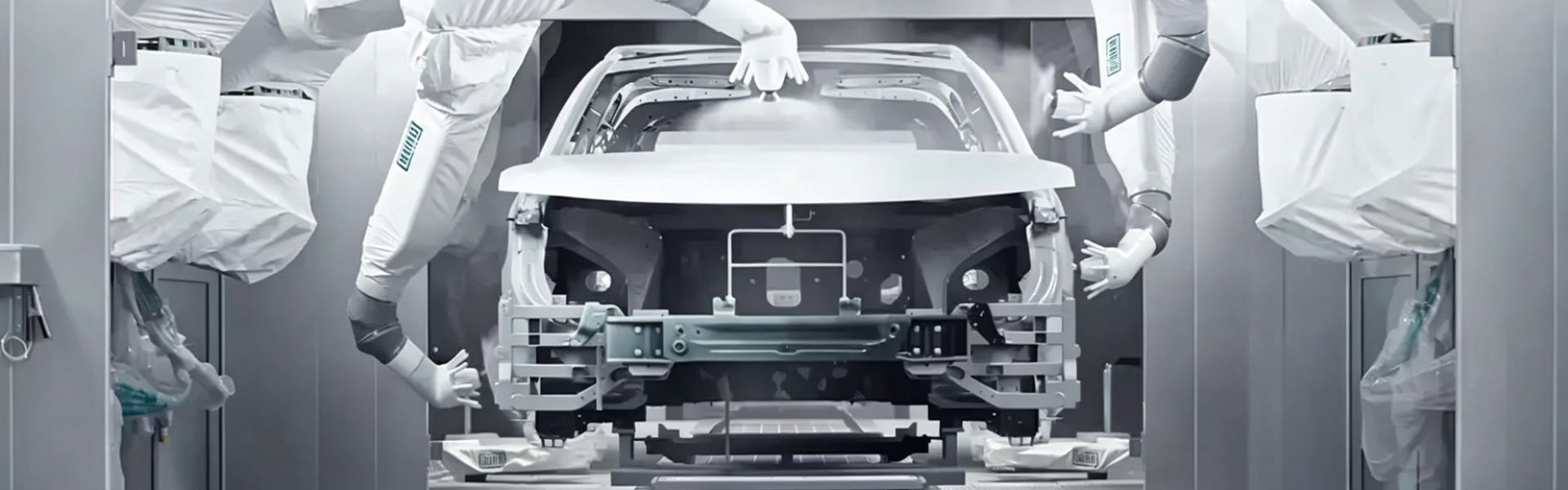
Commercial Vehicle Coating Line
Commercial Vehicle Coating Line --India Bus Automatic Paint Shop
The India bus automatic paint shop project was developed for large vehicle structures and high-intensity operating conditions. By integrating automated spraying, wet-on-wet coating technology, and intelligent conveying systems, the project enabled the transition from traditional manual painting to a highly efficient and stable production model.
During project implementation, lean production concepts and customized intelligent control solutions were introduced, significantly improving coating efficiency, quality consistency, and overall line stability, helping the customer establish a leading advantage in automated bus coating technology.
1. Pretreatment
Designed for large bus bodies and complex welded structures, the pretreatment process includes enhanced degreasing, multi-stage rinsing, surface conditioning, and phosphating.
In this project, the spray system and tank structures were optimized to ensure uniform treatment coverage of large components. Even complex structural areas achieved stable and consistent conversion coating performance. Combined with lean process control, the overall process stability was further improved, providing a solid foundation for continuous coating operations.
2. Electrocoating (ED)
Full-immersion electrocoating technology is applied to achieve complete coating coverage of bus bodies and frame structures.
In this project, electrocoating tank layouts and circulation systems were optimized to improve coating penetration capability for large structural components, ensuring reliable corrosion protection for internal cavities and hidden areas. Automated control systems also enable precise regulation of key process parameters, ensuring stable and reliable production performance.

3. Sealing & Underbody Protection
To meet demanding bus operating conditions, seam sealing and underbody protection processes were significantly reinforced.
In this project, sealing paths and underbody coating solutions were optimized, with reinforced coating protection applied to critical areas to improve water resistance, corrosion protection, and stone-chip resistance. These measures enhance structural durability and extend vehicle service life.
4. Primer
For large bus exterior panels, the primer process combines automated spraying with manual finishing to improve surface smoothness and coating quality.
During project execution, lean production systems were used to optimize spraying parameters and production takt, ensuring stable integration with subsequent continuous coating processes while improving the surface foundation for final appearance quality.
5. Top Coat
The topcoat process represents one of the key technological upgrades of this project. By integrating automated spraying systems with wet-on-wet coating technology, continuous coating operations were achieved while reducing intermediate sanding and material handling processes, significantly improving production efficiency.
During operation, intelligent control systems and optimized process parameters ensured uniform coating of large surfaces while maintaining excellent color consistency and stable appearance quality. The system demonstrated outstanding continuity and reliability during mass production and was highly recognized by the customer for its efficiency, coating consistency, and operational stability.
6. Curing
For large bus bodies, a high-efficiency energy-saving oven system was adopted to ensure uniform and stable heat distribution.
In this project, curing cycles and temperature control strategies were optimized to ensure stable curing performance for wet-on-wet coatings while reducing energy consumption and improving overall production efficiency.
7. Intelligent Conveying & System Integration
A highly customized intelligent conveying system was developed specifically for bus manufacturing applications, enabling efficient vehicle body transfer between production processes.
Through deep integration with the coating process, the production system was upgraded from traditional passive conveying to active scheduling, significantly improving line takt control capability. Combined with customized intelligent control systems, the line achieved stable operation under complex production conditions, laying the foundation for unmanned logistics and smart manufacturing.